
Skip to content

Redpoint Labs · an independent product lab

Software built around the way your business operates.

I work with your team to map how the work gets done, then build software that fits it and works with the tools you already use. The first version is live within a few weeks, and I support it after launch.

  • ~80% less task time in Vantage, running today
  • Works with the tools you already use
  • You deal with me, start to finish

Kevin Chung. Six years in B2B SaaS, now building for the industries it skipped.

A submission lands, gets matched and priced, and settles. Built for a recycling brokerage that ran on WhatsApp.

Redpoint Labs builds with

My product work has shipped at

Where the time goes

Three things that cost a growing business more every year.

  1. 01

    The same job gets entered three times.

    An order arrives by email, is copied into a spreadsheet and keyed again into the invoice, and every copy is another chance for a figure to drift.

    The cost rarely appears as one large error; it builds up as hours lost every week.

  2. 02

    The answers live in one person’s head.

    Knowing where a deal stands means asking the one person who tracks it, which works well until they are away.

    The business can only move as quickly as the person who holds the details.

  3. 03

    The software you pay for was built for someone else.

    Most CRMs and ERPs are designed for a generic company, so teams work around them and the spreadsheet quietly returns.

    You end up paying for the licence while the work is still done by hand.

These problems say little about how a business is run, and a great deal about software that was never designed for its industry.

In six years building B2B software at Checkfront, EverCommerce and Rallyware, I kept meeting businesses alongside those markets that were moving serious volume on tools made for someone else. Redpoint Labs builds for them, starting from the workflows their teams already rely on.

What you get

Software that fits, and someone who stays with it.

  1. 01

    A working system, built around how you already work.

    Live within a few weeks, running on your own data, doing the one job that costs you most.

  2. 02

    Connected to the tools you already use.

    Your email, your spreadsheets, your accounting. Nothing to rip out, and nothing for the team to unlearn on day one.

  3. 03

    Your team involved while it is built.

    They use it from the first weeks, so it fits how they work rather than how a manual says they should.

  4. 04

    Someone to keep it running.

    I stay on after launch for maintenance, and for changes as the business changes.

In place of

A platform licence sized for a company ten times yours, and the spreadsheet you keep anyway.

Where it starts

Half an hour on the phone. No pitch, and no quote until we both know what is worth building.

Projects

Do not take my word for it. Here it is, running.

Recycling commodity brokerage

Vantage

Open the live product

~80%less task time inside operator workflows

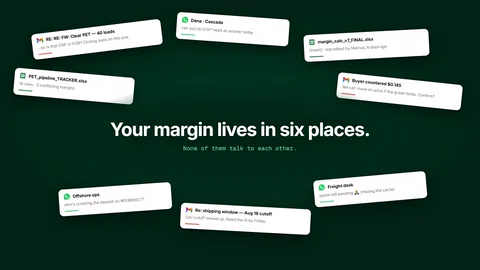
One deal, six places, and none of them talk to each other.

What it is

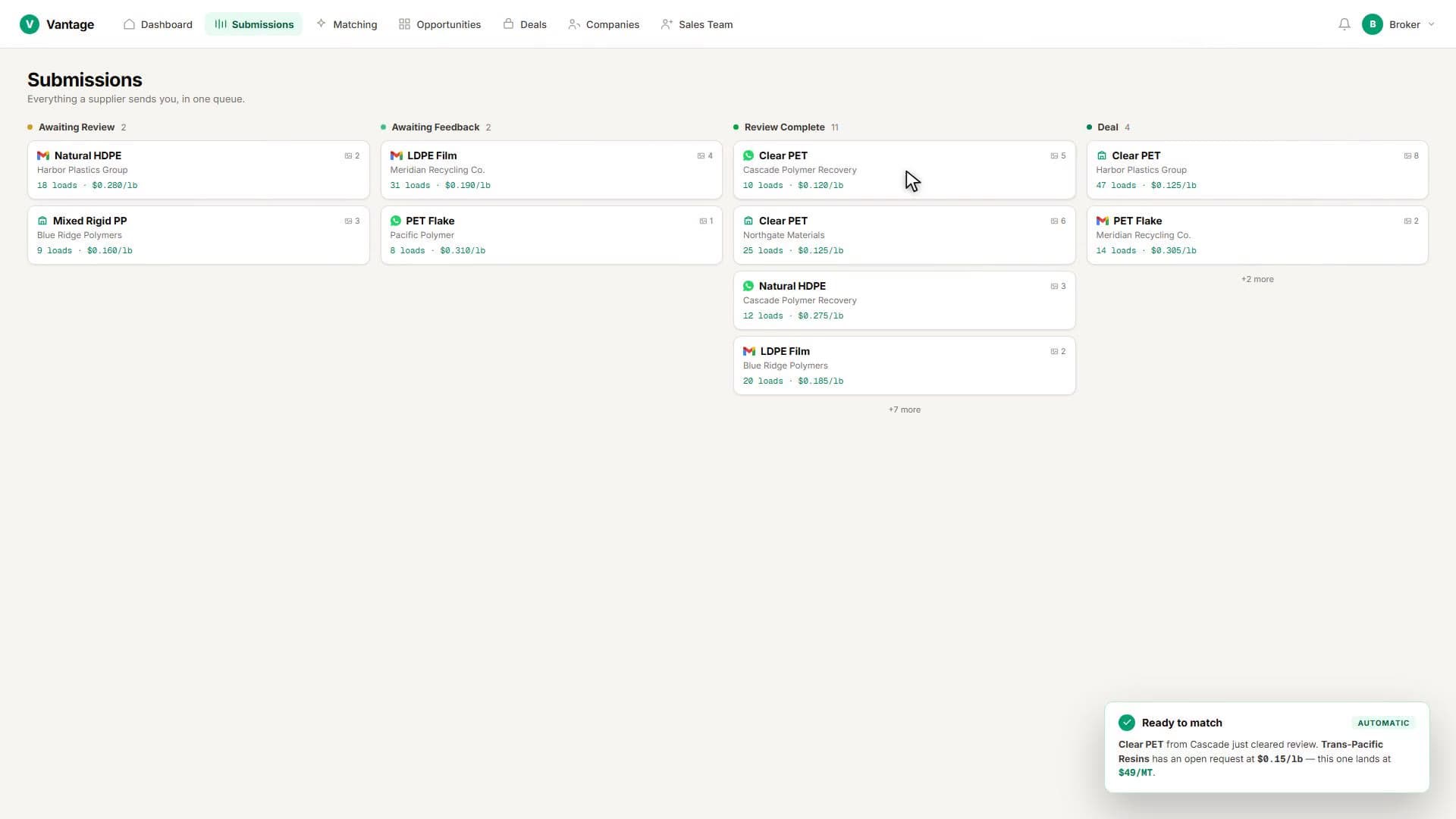
An AI-native deal pipeline for recycling brokers: intake, matching, pricing and settlement in one system.

What it does

The model does the reading, the broker keeps every decision, and every deal stays traceable.

Where the spreadsheet leaks time and money.

Two jobs a broker still does by hand, and what each looks like once Vantage does it.

Leaks money

Rebuilding the margin

Spread minus freight, per option, before you send.

Supplier price plus ocean freight against what the buyer pays, worked out per supplier and ranked. The option that loses money shows it before anything is sent.

Three supplier options with freight taken off: $49 a tonne marked healthy, $39 countered, and minus $6 marked not sent.

Leaks time

Chasing paperwork

Every reply and document files itself to the deal.

A deal picks up context at every step and drops most of it at every handoff, so Vantage holds the whole thing in one place from intake through settlement.

An email thread, a WhatsApp message, a draft bill of lading and a buyer's counter all file themselves to deal FE8B00C7, which then shows the next step: send the proforma invoice.

How a deal moves through Vantage

01Take in a submission

It lands from WhatsApp. It files itself.

Grade, photos, tonnage and price arrive already structured, in a single card. Move it and it tells you who’s waiting, and at what price.

02Match it to a buyer

Three suppliers, ranked by fit.

The hub scores every supplier against the buyer request and drafts one anonymised option per candidate. Supplier names stay hidden until the buyer picks one.

03Price the trade

One of these options loses money. It says so.

Supplier sell plus ocean freight against what the buyer pays, resolved per supplier and ranked. The losing option turns negative before anything is sent.

04Check the paperwork

The model reads. The rules decide.

AI reads the draft bill of lading and deterministic rules compare it field by field. Same answer every run, and here it caught the wrong discharge port.

Watch the full film1:34

Agency sales operations

Clareo

A portfolio piece, built as a prospective platform for an agency account.

Open the live product

Four tools per prospect, and the email still starts from a blank page.

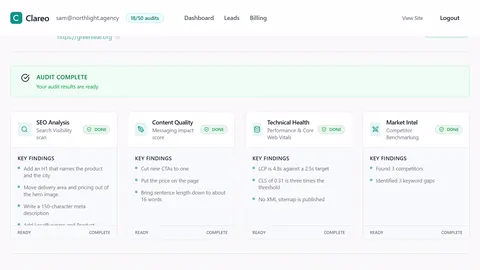
An AI-native prospect research tool for agencies. A form on the agency's site captures the lead, four specialist agents review the prospect's website, and back comes a scored report with the reply already drafted.

  • 4analyses run one at a time
  • 3-5 hrsper prospect, before anyone calls
  • 1email still written from nothing
Watch the full film0:34

Case study: building permits, Alberta

Veri

Built for the Building Codes Challenge in Venture Pilots: Built World Tech 2026, an Edmonton Unlimited pilot program funded in part by the Government of Alberta.

The case prompt

“Create an AI-powered tool that ensures innovators and builders prepare a complete, code-referenced alternative solution application before it ever reaches a Safety Codes Officer.”

The business challenge

Alberta has over 430 building jurisdictions, and applicants work out the right code articles and supporting analysis largely on their own. Many submissions arrive incomplete, which drives weeks to months of back-and-forth before a decision. The cost in labour, errors and delay runs from a few hundred dollars to tens of thousands, and new ideas get dropped or go to other jurisdictions.

What I set out to solve

  • Applicants hunt for the right rule alone. Veri finds the code article that applies and looks the number up in the code, so none is made up.
  • Submissions arrive incomplete. Every application is checked against the six items the code asks for in every variance before it is sent.
  • Builders ask for variances they don't need. Veri shows ways to meet the rule as written first, and only builds a variance when one is needed.
  • Weeks to months of back-and-forth. The officer gets a request already checked part by part, with the proof attached, so fewer rounds go back.
  • Officers read 2 to 200 pages per request. Each request opens with an at-a-glance summary and a first pass that point to the evidence, and the officer still makes every decision.

Builders ask for variances they don't need, and miss what the ones they do need require.

An AI-native assistant for building code variances. The applicant drops in a design brief; Veri finds the rule that applies, shows ways to meet it without a variance, and builds the application with the proof attached. The Safety Codes Officer gets the same request already checked, part by part.

  • 6items the code asks for in every variance, and most applications miss some
  • 2-200pages an officer reads per request
  • 0rule numbers made up: each one is looked up in the code
Watch the film1:45

Over time

What changes, and roughly when.

Timing depends on scope. The order is what holds.

  1. First weeks

    A first version, live

    I spend days with the people doing the work, then build the part that costs you most. Your team is using it within a few weeks.

  2. First months

    The retyping stops

    Each piece builds on the last. Information is entered once and shows up everywhere it is needed.

  3. Within the year

    You see the whole business at once

    Where every job stands, what it is earning and what is running late, without having to ask anyone.

  4. From then on

    It grows with the business

    New staff learn the system, not the spreadsheet. When the way you work changes, the software changes with it.

Kevin Chung

I read the workflow before anyone writes code.

I’m Kevin Chung. Six years as a product manager in B2B SaaS: payments at EverCommerce, core platform and APIs at Checkfront, zero to one at Rallyware.

Redpoint Labs is a lab before it is a practice. Most of what is here I built because I wanted it to exist: B2B workflow on one side, consumer on the other. A small number of owners have asked me to build theirs, and I take on a few of those a year.

Consumer health

Backproof

In private beta. React Native and Expo.

Recovery fails between appointments, not during them.

Two things end a programme: not knowing what to do today, and not being able to feel three months of slow progress. Backproof answers the first with one question a day, and the second with the record of every day before it.

See how it works

Track record

Seven teams, one job.

Understand how the work actually gets done, then find the smallest change that moves the economics. Here is what that has been worth.

  1. EverCommerce

    2025 – 2026

    Product Manager, Payments

    Payments for home-service trades, where the product decision and the interchange economics are the same decision.

    • +7%average job size across 6,800 merchants
  2. Checkfront

    2025

    Product Manager, Core and APIs

    The platform layer underneath everything else. One decision there reaches every customer at once.

    • $1B+gross booking volume through the gift card launch
    • +15%ARPU across 3M+ users
  3. Traction Rec

    2023 – 2024

    Product Manager

    Community recreation software, where the people using it are front-desk staff who cannot be trained for a week before a season starts.

    • +15%cart conversion through AI-enabled UX
  4. Rallyware

    Mar 2022 – 2023

    Product Manager, B2B SaaS

    Enterprise learning at 300,000-user scale, where the account that threatens to leave and the account you are trying to launch are the same week's work.

    • $2Mnet new ARR from the largest customer closed
    • $500KARR saved through a retention strategy on a churning account
    • 400%reduction in customer time-to-launch
  5. Pilot

    May 2021 – Jan 2022

    Product Manager, B2C SaaS

    A consumer product with no roadmap and no research practice. Both had to exist before anything could ship.

    • 3core feature sets taken from zero to one, including privacy and maps
  6. KPMG

    Fall 2020, Sep 2021 – Mar 2022

    Management Consultant, Product Strategy

    Sole product manager on an information management tool, in front of the executives who would decide whether it got renewed.

    • $500Kcontract renewal generated on the project
  7. SAP

    2019

    Project Coordinator, eCommerce

    Ran the ceremonies for a team of eleven, and learned that a sprint misses its number for reasons nobody raises in the standup.

    • 95%sprint accuracy, up from 80% across the team

You will be talking to me, Kevin.

Is your industry still on a spreadsheet?

Tell me what the business does and the outcome you want. Half an hour, no pitch. Often the answer is that a build is not worth it, and that is a useful half hour too.

[email protected]